Play Journal #1 Rewrite (Pac-Man)
According to the article, “Game Analysis: Centipede”, during what people would refer to as a “Golden Age” of classic arcade games, many games lackluster in quality fell through the cracks of history while some like Pac-Man went on to become household names in the video game world. Pac-Man shares many of the characteristics that Rouse describes in his article on classic arcade games. It’s a game that is simple and easy to pick up on for any and all players, it’s addictive and unending, and it has a scoring system, all of which play into the game’s success and popularity worldwide.
As far as gameplay goes, Pac-Man is easy enough for anyone to pick up, most likely in part to the fact that there are not any “special moves involving large button combinations” (Rouse 465). The player controls Pac-Man and moves him about in a maze picking up dots that grant him 10 points a pop. All the while, he is being chased by 4 different colored ghosts that move around him in random paths, and it’s the player’s job to avoid them or risk losing one of three lives if they touch the ghosts. There are several items the player can grab for extra points, and if they manage to gain 10,000 points they receive one extra life. Additionally, another factor in why the game may be instinctively easy for players to pick up is its input design. The game’s use of the “cabinet and controller” design that allows the player to use a joystick to move Pac-Man in just four directions allows them to “easily and intuitively understand the relationship between the manipulation of the controls and their movement” (Rouse 467).
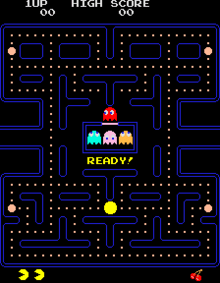
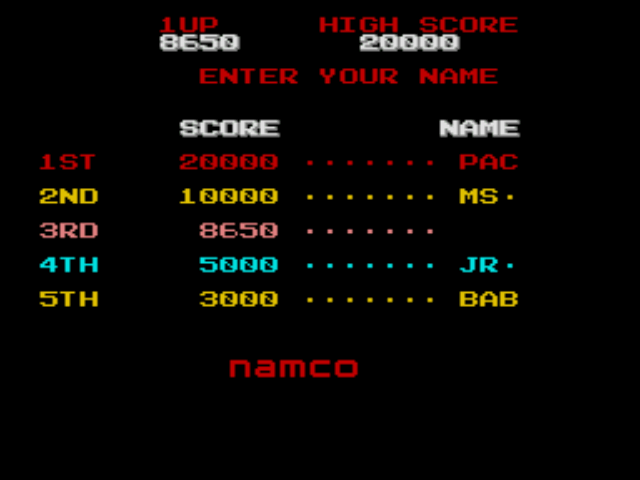
Another trait that Rouse touches on in his analysis of Centipede that he considers to be significant to that game’s success that is shared in Pac-Man is the concept of “infinite play”. Because each game of Pac-Man ends with him dying, “there is no ending to the game, and hence no winning it either” (Rouse 463). As you progress through each level, the ghosts start to move faster and faster and begin to chase after you with predictive movements rather than randomly encountering you, and your powerups lose their effectiveness. The design of an unending game with a “continuous, infinite ramping up of difficulty” (Rouse 463) also makes it so that players continue trying their best to either beat their previous level or the highest score on the leaderboards, which plays into the fact that bragging rights also played a major role in the game’s success. At the end, the “bragging rights” that Rouse mentions come into play in a big way as the game can show which players have the highest scores, which results in players wanting to beat whoever is above them to “prove their mettle” (Rouse 464).
Pac-Man has all of the hallmark traits of what Rouse describes as a truly “classic arcade” game. It is a perfect blend of simplicity that draws in any and all who desire to drop in a few quarters to play, and slowly but surely cranks up the difficulty. It isn’t the most technologically advanced game, but it is and will always remain a classic in the hearts of gamers all around.
Follow My Blog
Get new content delivered directly to your inbox.
 RTF 331P Play Journal (Jae Bak)