Play Journal #4 – Journey
Journey was one of the most pleasurable gaming sessions I have ever had the fortune of experiencing since I started playing video games as a child. I found myself on a spiritual adventure that I would never have expected to go on in a million years. I attribute this experience to the emotions that were invoked in me through the game’s aesthetics both visually and through its sound design that allowed for an immense amount of immersion within the world of the game.
Two of Simon Niedenthal’s meanings of game aesthetics apply greatly to Journey which are that aesthetics are “sensory phenomena…the way a game looks and presents itself to the player” and that aesthetics are “an expression of the game experienced as pleasure, emotion, sociability”. In Journey, it’s easy to see that one of these definitions plays into the other, meaning that this game’s pure visual beauty evokes emotion and pleasure in our minds. In the beginning, the player is dropped off in the middle of a desert, and your only objective is to walk around and view the world and wander around until you find something interesting to explore. Now, if you play the game by yourself (as I did) the feeling of isolation and loneliness is almost instantaneous. In the figure below, we see a view of the landscape we are thrown into, and for a good while, that’s all the player can see and walk through, creating this sense of nothingness inside of you, wandering around for someone or something to interact with.

However, as the game progresses so do the emotions felt that come with its visual aesthetics. Take for instance, the figure below which shows a moment where the player is floating through an ocean-like space. It is one of the most calm and relaxing spaces in the world, and overloads the senses with happiness as you float around, giving off an “aesthetic trapping” that provides us with sensations that immerse us as well as bring us to near tears (Niedenthal).
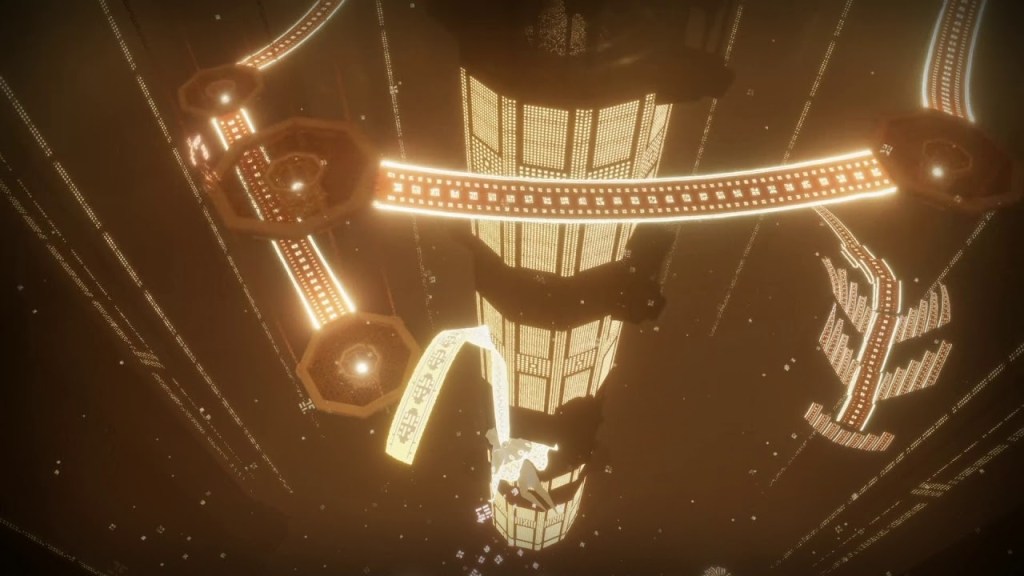
When it comes to the sound design of the game, one can’t help but to turn to what Karen Collins describes as “imaginative immersion” In various stages of the game, there are moments when the music swells as the actions do, and in the figure below, as we slide through a city that is reminiscent of what Heaven looks like, we hear music that makes us feel like we’re in a movie, and gives us a fantastical feeling inside. Through the music, we can put ourselves into the shoes of the player in the game, becoming a part of their world (Collins). One of the player’s key abilities is also to sing, which sounds like a ringing hum that only adds to the mystical feeling. The singing and the music heavily immerse players and are factors that allows players to “enjoy the fantasy of the game” (Collins).
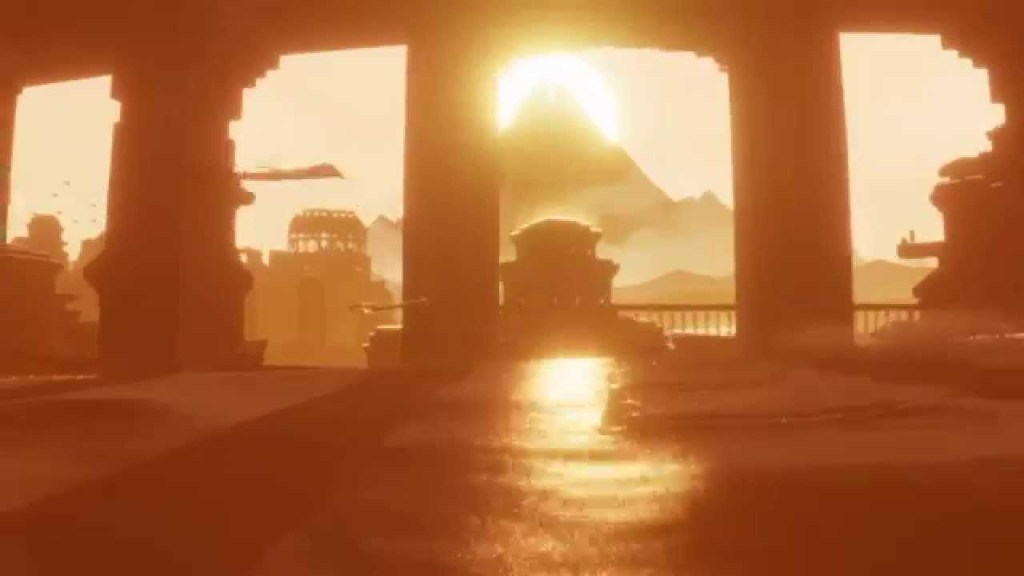
The way the game looks, plays, feels, and sounds allow for the gameplay to be “rooted into our physical being” (Niedenthal), which allow us to be totally immersed and make us vulnerable to the emotions that are wedged into us as we go on.
 RTF 331P Play Journal (Jae Bak)