Play Journal #3 – Portal 2
Portal 2 is a game in which the mechanical boundaries of physics and space are skyrocketed into the stratosphere, encapsulated in gameplay that displays a near-perfect blend of sci-fi theatrics, witty robotic narration, and a force that drives players to implement out-of-the-box thinking to solve challenges that rise in difficulty in order to progress in the game. The game starts by giving a simple puzzle that allows the player to get a grasp of how the game works, as seen in the figure below.

The mechanics of the game are designed to allow a player to progress through the game by solving puzzles that get progressively more challenging as the player obtains new abilities. As Miguel Sicart describes in his article “Defining Game Mechanics”, the game’s mechanics boil down into how certain verbs act in the game. The main mechanics of Portal 2 are jumping, shooting the portal gun, and grabbing the boxes. In order for the player to complete a stage, they must move boxes from one part of the room and place them on large buttons on the floor in order to open the door to the next level. Moving the boxes can require some complex movements and tricks with the portal gun which can place portals essentially anywhere in the room, although most levels require specific placement of the portals in order to reach the boxes. These methods allow for agency within the game world and give players a limited and predetermined set of actions that they can take within the space of possibility in order to accomplish the tasks of the game (Sicart).
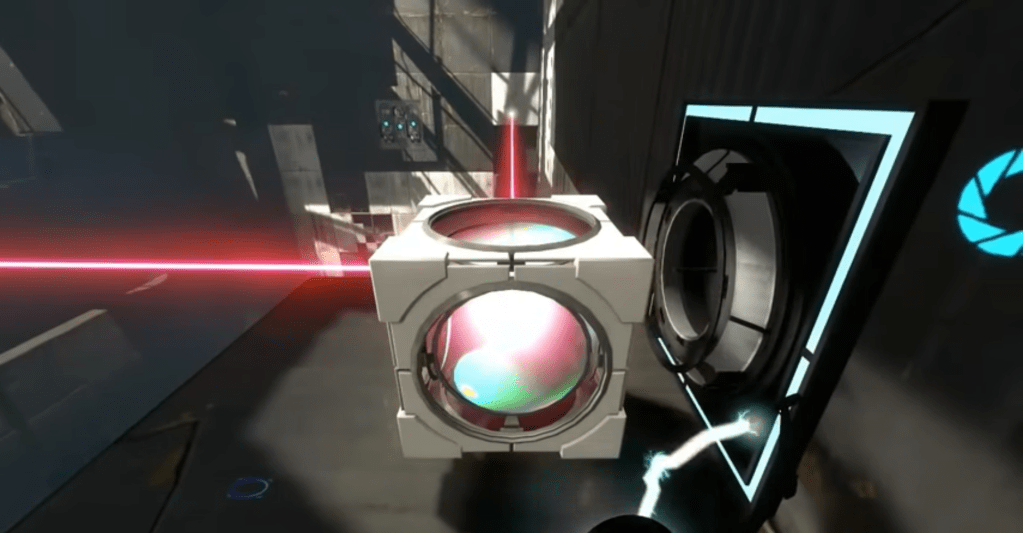
If we take a look at the figure below we can see that the game requires what Sicart describes as contextual mechanics which are “analytical concepts that can be used to understand how players decode the information in a level” (Sicart). This comes into play heavily when playing Portal 2 because the movements and placements of the portals become increasingly specific and intricate and demand that the player be able to accurately read the room of the level and determine exactly where the portals need to go in order the get the boxes where they need to be. The players in the game communicate with different portions of the level and the room and break down specific areas in order to solve the puzzles set forth, and thus the contextual mechanics are extremely apparent in that the player is continuously forced to read and analyze the data that comes through in each room (Sicart).
Portal 2 is a game in which mass amounts of critical thinking and some patience are required. But overall, the mechanics make the game extremely unique and challenging, and gives it a feeling of accomplishment when you pass that level that took you almost an hour to finish.
Sicart, Miguel. Game Studies – Defining Game Mechanics, gamestudies.org/0802/articles/sicart
 RTF 331P Play Journal (Jae Bak)